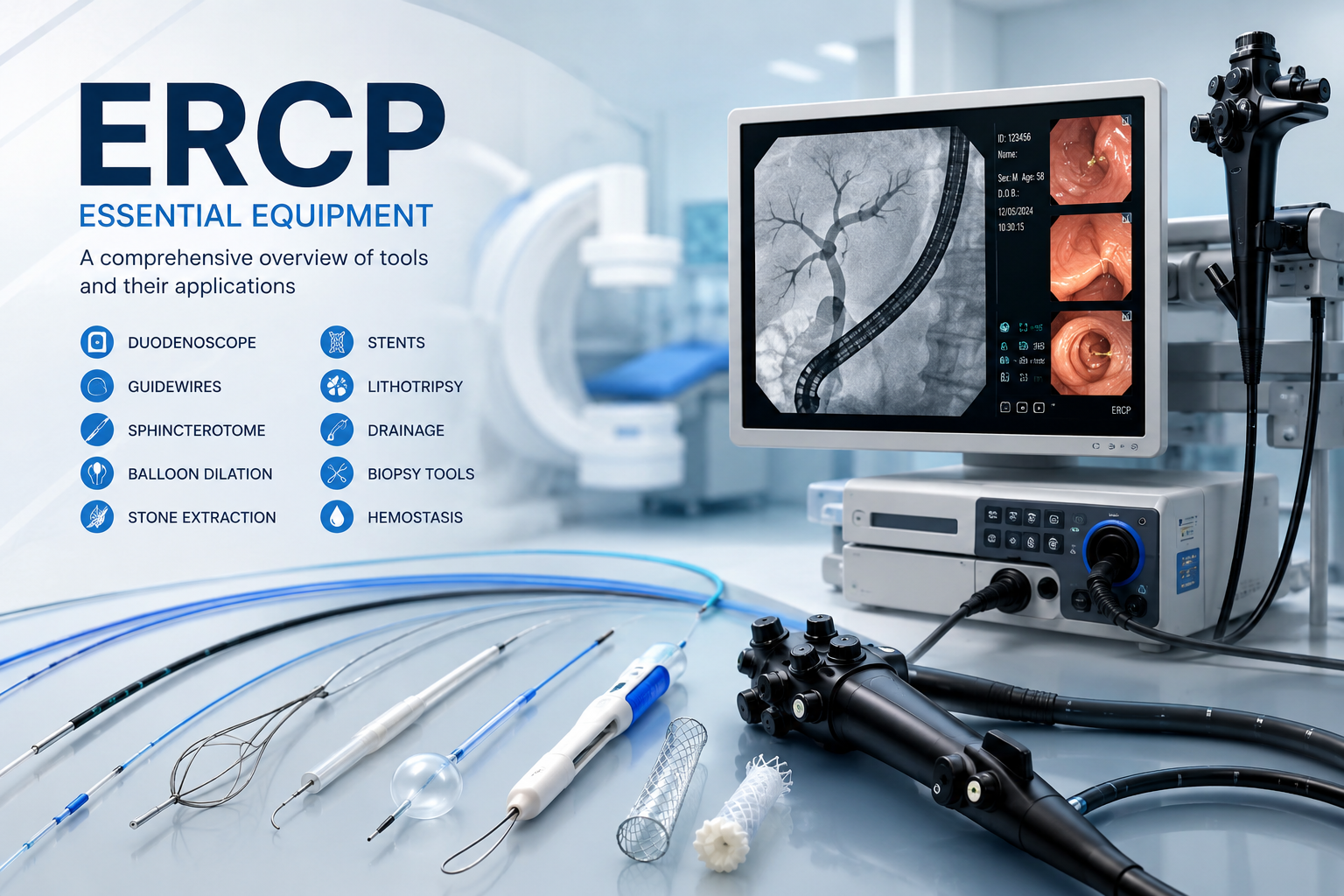
Essential Equipment for ERCP: A Comprehensive Guide to Devices, Instruments, and Their Applications
Endoscopic Retrograde Cholangiopancreatography (ERCP) is an advanced endoscopic procedure used primarily for the diagnosis and treatment of disorders affecting the biliary and pancreatic ducts. Unlike conventional diagnostic endoscopy, modern ERCP is predominantly therapeutic and requires a specialized combination of endoscopic, imaging, guidewire, cutting, dilation, drainage, and accessory devices.
Because ERCP involves delicate anatomical structures and potentially complex interventions, selecting appropriate equipment is critical for procedural efficiency, patient safety, infection control, and successful clinical outcomes. Hospitals and healthcare centers should therefore understand not only which devices are required, but also the specific function and clinical application of each instrument.
This article provides a professional overview of the essential equipment used during ERCP and explains the role of each category of device.
1. ERCP Duodenoscope
The duodenoscope is the primary endoscope used for ERCP. Unlike a standard gastroscope, it is specifically designed with a side-viewing optical system and a specialized distal tip that facilitates visualization and cannulation of the major duodenal papilla.
Main functions
The duodenoscope allows the physician to:
- Locate the major and minor papilla
- Access the biliary and pancreatic ducts
- Introduce guidewires and therapeutic accessories
- Perform sphincterotomy and dilation
- Place biliary or pancreatic stents
- Remove stones and other obstructive materials
Modern therapeutic duodenoscopes generally feature a large working channel to accommodate multiple ERCP accessories.
2. Guidewires
Guidewires are among the most important accessories in ERCP. They provide a controlled pathway into the bile or pancreatic duct and allow other devices to be advanced safely.
Guidewires are available in different diameters, lengths, tip configurations, coatings, and levels of flexibility.
Applications
Guidewires are commonly used for:
- Selective biliary cannulation
- Pancreatic duct access
- Navigation across strictures
- Placement of stents
- Balloon dilation
- Stone extraction procedures
A suitable guidewire should provide an appropriate balance between flexibility, visibility, torque control, and resistance to kinking.
3. ERCP Cannulas and Sphincterotomes
Cannulas are used to access the papilla and introduce contrast material into the biliary or pancreatic duct.
Sphincterotomes combine cannulation capability with an electrosurgical cutting wire, allowing the physician to perform endoscopic sphincterotomy.
Clinical applications
These devices are used for:
- Initial duct cannulation
- Contrast injection
- Biliary sphincterotomy
- Pancreatic sphincterotomy in selected cases
- Facilitation of guidewire placement
The choice between a standard cannula and a sphincterotome depends on the anatomy and the planned intervention.
4. Contrast Injection System
Contrast media are used during fluoroscopic imaging to visualize the biliary and pancreatic ductal systems.
A typical ERCP contrast system may include:
- Contrast syringe
- Injection catheter
- Tubing
- Pressure-controlled or manual injection components
Contrast injection allows the physician to identify:
- Bile duct stones
- Biliary strictures
- Ductal obstruction
- Bile leaks
- Anatomical abnormalities
- Pancreatic duct abnormalities
Careful contrast administration is important because excessive injection pressure can contribute to complications such as pancreatitis or ductal injury.
5. Fluoroscopy and Radiographic Equipment
Fluoroscopy provides real-time X-ray imaging during ERCP. It is essential for confirming ductal anatomy, identifying abnormalities, guiding interventions, and verifying the position of therapeutic devices.
A modern ERCP suite generally requires:
- Fluoroscopy system
- Radiographic table
- Image display system
- Radiation protection equipment
- Appropriate image storage and documentation systems
Radiation safety measures should be implemented for both patients and healthcare personnel.
6. Biliary and Pancreatic Stents
Stents are used to maintain ductal drainage when the normal flow of bile or pancreatic secretions is compromised.
Plastic stents
Plastic stents are commonly used for:
- Benign biliary strictures
- Temporary biliary drainage
- Bile leaks
- Selected cases of malignant obstruction
- Pancreatic duct drainage
Self-Expanding Metal Stents
Metal stents are frequently used in selected cases of malignant biliary obstruction. Depending on the clinical indication, they may be uncovered, partially covered, or fully covered.
The choice of stent depends on factors such as:
- Location of obstruction
- Etiology of the stricture
- Expected duration of treatment
- Need for future access
- Patient anatomy
7. Stone Extraction Balloons
Extraction balloons are designed to remove stones, sludge, and other obstructive material from the bile duct.
After positioning the balloon beyond the target material, the physician inflates it and gently pulls it toward the papilla, allowing the contents of the duct to be swept out.
Common applications
- Common bile duct stone extraction
- Biliary sludge removal
- Clearance of residual ductal material
- Assistance after sphincterotomy
Balloon size should be selected according to duct diameter and the specific clinical situation.
8. Retrieval Baskets
Baskets are another important tool for removing biliary stones. They can capture stones within the bile duct and facilitate controlled extraction.
Common basket designs include:
- Dormia-type baskets
- Wire baskets
- Mechanical lithotripsy-compatible baskets
Baskets can be particularly useful when stones are difficult to remove with balloon extraction alone.
9. Mechanical Lithotripsy Devices
Large or impacted bile duct stones may not pass through the papilla using conventional extraction techniques. Mechanical lithotripsy devices can fragment these stones into smaller pieces.
The fragmented material can then be removed using balloons or retrieval baskets.
Mechanical lithotripsy may be considered when:
- Stones are large
- Stones are impacted
- Conventional extraction fails
- The anatomy makes direct extraction difficult
10. Dilation Balloons
Balloon dilation devices are used to enlarge narrowed areas within the biliary or pancreatic duct or, in selected circumstances, the papillary opening.
They are available in different diameters and lengths.
Applications include:
- Treatment of benign biliary strictures
- Selected malignant strictures
- Dilation before stone extraction
- Management of postoperative or anastomotic strictures
- Selected papillary large-balloon dilation procedures
Dilation should be performed carefully and according to the anatomical and clinical circumstances.
11. Nasobiliary Drainage Catheters
A nasobiliary drainage catheter provides temporary external drainage of bile through the nose.
It may be used in selected situations such as:
- Acute biliary infection requiring drainage
- Difficult-to-manage biliary obstruction
- Bile duct monitoring
- Selected cases requiring repeated cholangiography
- Temporary drainage when definitive treatment is delayed
Although internal stenting is often preferred for many indications, nasobiliary drainage remains useful in specific clinical circumstances.
12. Biopsy and Sampling Accessories
ERCP may require tissue or fluid sampling when a biliary or pancreatic abnormality needs further evaluation.
Depending on the indication, sampling may involve:
- Biliary brush cytology
- Biopsy forceps
- Bile aspiration
- Specialized tissue acquisition systems
These tools are particularly relevant when malignancy or an indeterminate biliary stricture is suspected.
13. Electrosurgical Generator
An electrosurgical generator is essential when procedures such as sphincterotomy are performed.
It provides controlled electrical energy to the cutting wire of the sphincterotome.
The system should be compatible with the selected ERCP accessories and used according to the manufacturer’s instructions and institutional protocols.
14. Hemostasis Devices
Bleeding is a recognized potential complication of ERCP, particularly after sphincterotomy. ERCP units should therefore have appropriate hemostatic equipment available.
Depending on the clinical situation, available options may include:
- Injection needles
- Hemostatic clips
- Balloon tamponade
- Thermal coagulation devices
- Specialized hemostatic agents
The appropriate method depends on the location and severity of bleeding and the physician’s assessment.
15. Pancreatic Stents
Temporary pancreatic duct stents may be used for specific therapeutic indications and, in selected patients, for prevention of post-ERCP pancreatitis.
Their use depends on patient risk factors, procedural circumstances, and established clinical protocols.
Pancreatic stents differ in:
- Diameter
- Length
- Configuration
- Flange design
- Intended duration of placement
Correct selection and placement are essential because inappropriate stent selection can result in migration, obstruction, or ductal injury.
16. Injection Needles
Injection needles are introduced through the working channel of the duodenoscope and can be used for several therapeutic purposes.
Applications may include:
- Injection of diluted solutions for hemostasis
- Selected submucosal injections
- Administration of agents during specific endoscopic interventions
They are generally used as complementary accessories rather than primary ERCP devices.
17. Accessories for Difficult Cannulation
Selective biliary cannulation can sometimes be challenging because of anatomical variations, altered anatomy, periampullary diverticula, previous procedures, or other factors.
Depending on the circumstances, specialized equipment may include:
- Different types of guidewires
- Pre-cut sphincterotomy devices
- Needle-knife accessories
- Pancreatic guidewire techniques
- Specialized cannulation catheters
These techniques require advanced expertise and should be performed by appropriately trained ERCP specialists.
18. Patient Monitoring and Anesthesia Equipment
ERCP is not solely an endoscopic procedure; appropriate patient monitoring is an essential component of the ERCP environment.
Depending on institutional practice and patient factors, equipment may include:
- Pulse oximeter
- Non-invasive blood pressure monitor
- ECG monitoring
- Capnography
- Oxygen delivery systems
- Suction equipment
- Airway management equipment
An appropriately equipped recovery area is also necessary for post-procedure monitoring.
19. Suction and Irrigation Systems
Effective suction and irrigation help maintain visualization and remove secretions or fluids during the procedure.
A reliable suction system is particularly important during:
- Endoscopic examination
- Aspiration of secretions
- Removal of blood or debris
- Management of certain procedural complications
20. Infection Prevention and Reprocessing Equipment
Because duodenoscopes are complex reusable medical devices, infection prevention is a critical part of ERCP practice.
A healthcare facility should have appropriate systems for:
- Bedside pre-cleaning
- Manual cleaning
- High-level disinfection or sterilization according to applicable requirements
- Drying
- Storage
- Traceability and documentation
ERCP accessories intended for single use should be handled according to their labeling and institutional infection-control policies.
Essential ERCP Equipment at a Glance
| Equipment | Primary Function |
|---|---|
| Therapeutic duodenoscope | Visualization and access to the papilla |
| Guidewire | Ductal access and device guidance |
| Cannula | Cannulation and contrast injection |
| Sphincterotome | Cannulation and sphincterotomy |
| Fluoroscopy system | Real-time ductal imaging |
| Contrast system | Visualization of ducts |
| Extraction balloon | Stone and sludge extraction |
| Retrieval basket | Stone capture and removal |
| Lithotripsy device | Fragmentation of large stones |
| Dilation balloon | Stricture or papillary dilation |
| Plastic stent | Temporary ductal drainage |
| Metal stent | Long-term drainage in selected cases |
| Nasobiliary catheter | Temporary external biliary drainage |
| Biopsy/brush devices | Tissue and cytological sampling |
| Electrosurgical generator | Controlled electrosurgical cutting |
| Hemostasis devices | Management of bleeding |
| Monitoring equipment | Patient safety and physiological monitoring |
| Reprocessing equipment | Infection prevention |
How to Select ERCP Equipment for a Healthcare Facility
Choosing ERCP equipment should not be based solely on the purchase price. Hospitals should evaluate the entire clinical and operational environment.
1. Clinical Requirements
The equipment portfolio should reflect the procedures routinely performed by the ERCP team. A center treating complex biliary stones may require a broader range of extraction baskets, lithotripsy systems, and dilation balloons than a center performing primarily diagnostic or drainage procedures.
2. Compatibility
Accessories should be compatible with the available duodenoscopes, working-channel dimensions, electrosurgical generators, fluoroscopy systems, and other equipment.
3. Quality and Reliability
Because ERCP instruments are used in technically demanding procedures, consistent mechanical performance, controlled deployment, visibility under fluoroscopy, and reliable handling are important purchasing criteria.
4. Sterility and Infection Control
Hospitals should distinguish clearly between reusable and single-use devices and establish appropriate reprocessing protocols for reusable equipment.
5. Availability and Supply Chain
A reliable supply of essential accessories is critical. Hospitals should maintain appropriate inventory levels for frequently used items and have contingency options for high-priority devices.
6. Physician Preference and Training
ERCP accessories differ considerably in design and handling characteristics. Equipment selection should therefore involve experienced endoscopists and clinical staff who understand the practical advantages and limitations of different devices.
Conclusion
ERCP is a highly specialized therapeutic procedure that depends on a coordinated set of endoscopic, radiological, surgical, and drainage accessories. The therapeutic duodenoscope provides the foundation, while guidewires, cannulas, sphincterotomes, balloons, baskets, lithotripsy devices, stents, and sampling accessories enable physicians to manage a wide range of biliary and pancreatic disorders.
For hospitals and healthcare centers, effective ERCP equipment selection should focus on clinical requirements, device compatibility, safety, reliability, infection control, physician experience, and supply continuity rather than simply choosing the lowest-cost products.
A well-planned ERCP equipment portfolio can improve procedural efficiency, support the management of complex cases, and contribute to a safer and more standardized endoscopy service.